4 Levels of Recursive Self-Improvement

People talk about recursive self-improvement (RSI) from an implementation perspective. AI optimizes itself, and that would lead to an intelligence explosion. RSI sounds like an interesting concept, but what does it mean, and why would it lead to an explosion at all? Instead of diving into implementations, we think it is worth looking at RSI from a more macro, outcome-focused view. We will use a simple framework with a built-in grading scale, just precise enough to be falsifiable.
The returns on R&D diminish
R&D means the effort of improving a technology, and for almost all such efforts the same thing happens. The more cumulative effort has gone in, the less one additional unit of effort buys.
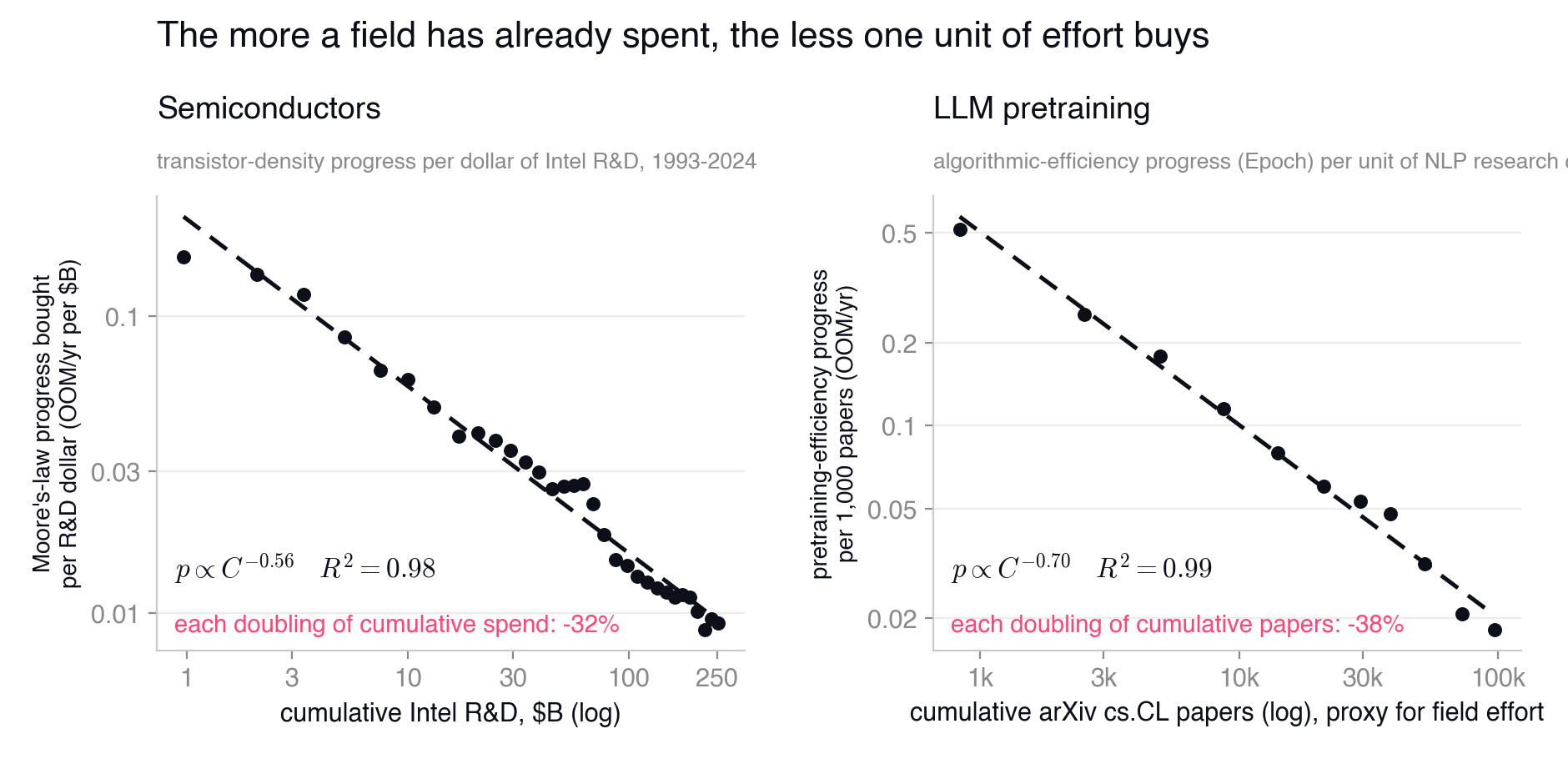
Both panels are real series, reproduced end-to-end from primary sources, Intel SEC filings and Epoch (Ho et al. 2024).
One number to carry: in semiconductors, each doubling of cumulative R&D has bought roughly a third less research productivity. Moore's law held its pace because the investment underneath it grew exponentially to compensate.
RSI breaks the need for exponential investment
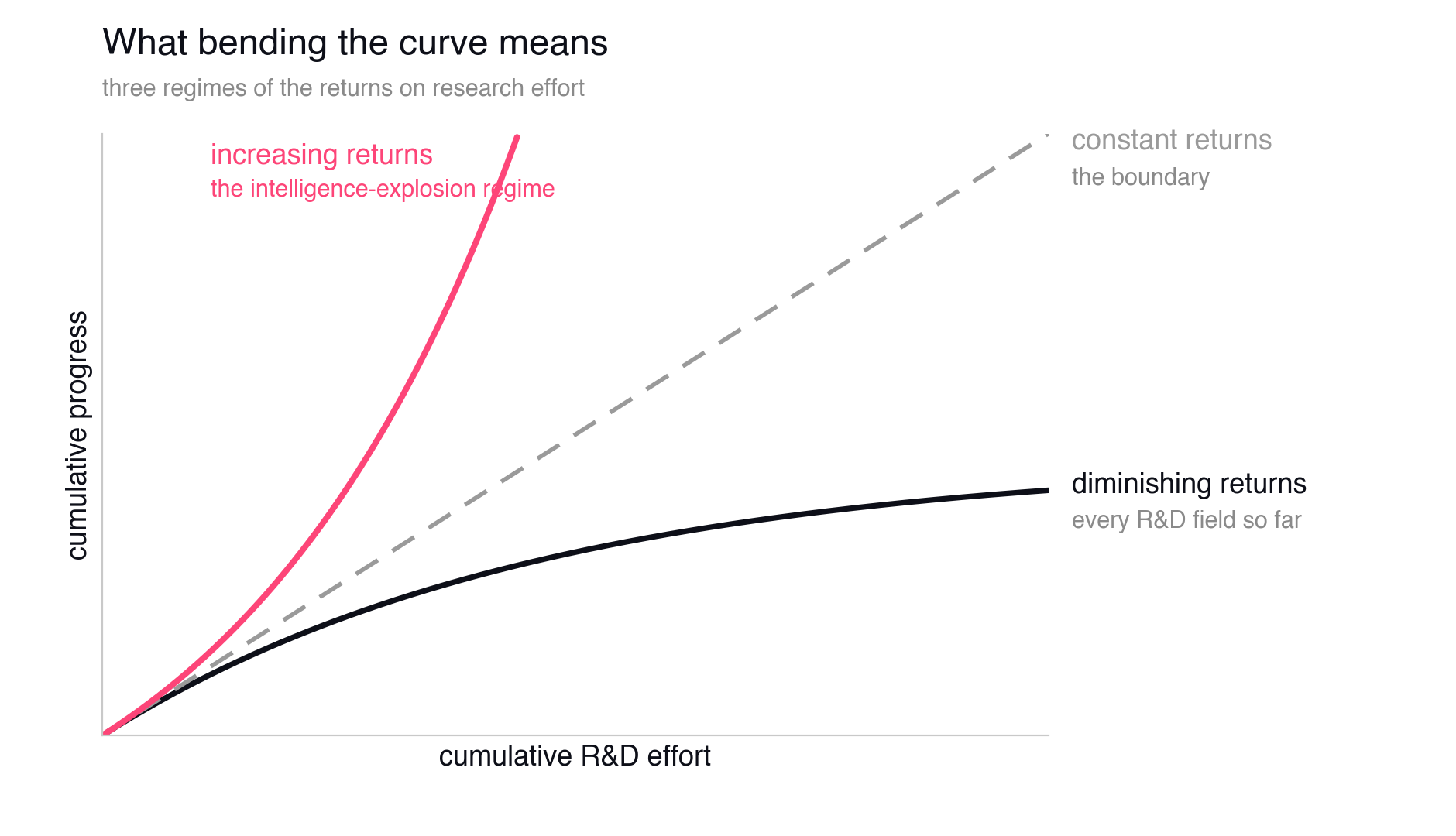
The promise of RSI is a loop that pushes against this. If the R&D you do can directly improve the scientist conducting the R&D, the positive feedback can potentially outweigh the rising difficulty. If that happens, we enter the territory of an intelligence explosion.
Why has this never happened before? Not because the scientist never improved. Education, method and tools have always fed back into the scientist. But that loop runs on generational timescales, through a fixed biological substrate, and its gains transfer lossily from one mind to the next. Its rate never came close to the pace at which problems get harder. The RSI bet is the same loop closed in machine time, on an editable substrate, with lossless copies.
Levels of recursive self-improvement
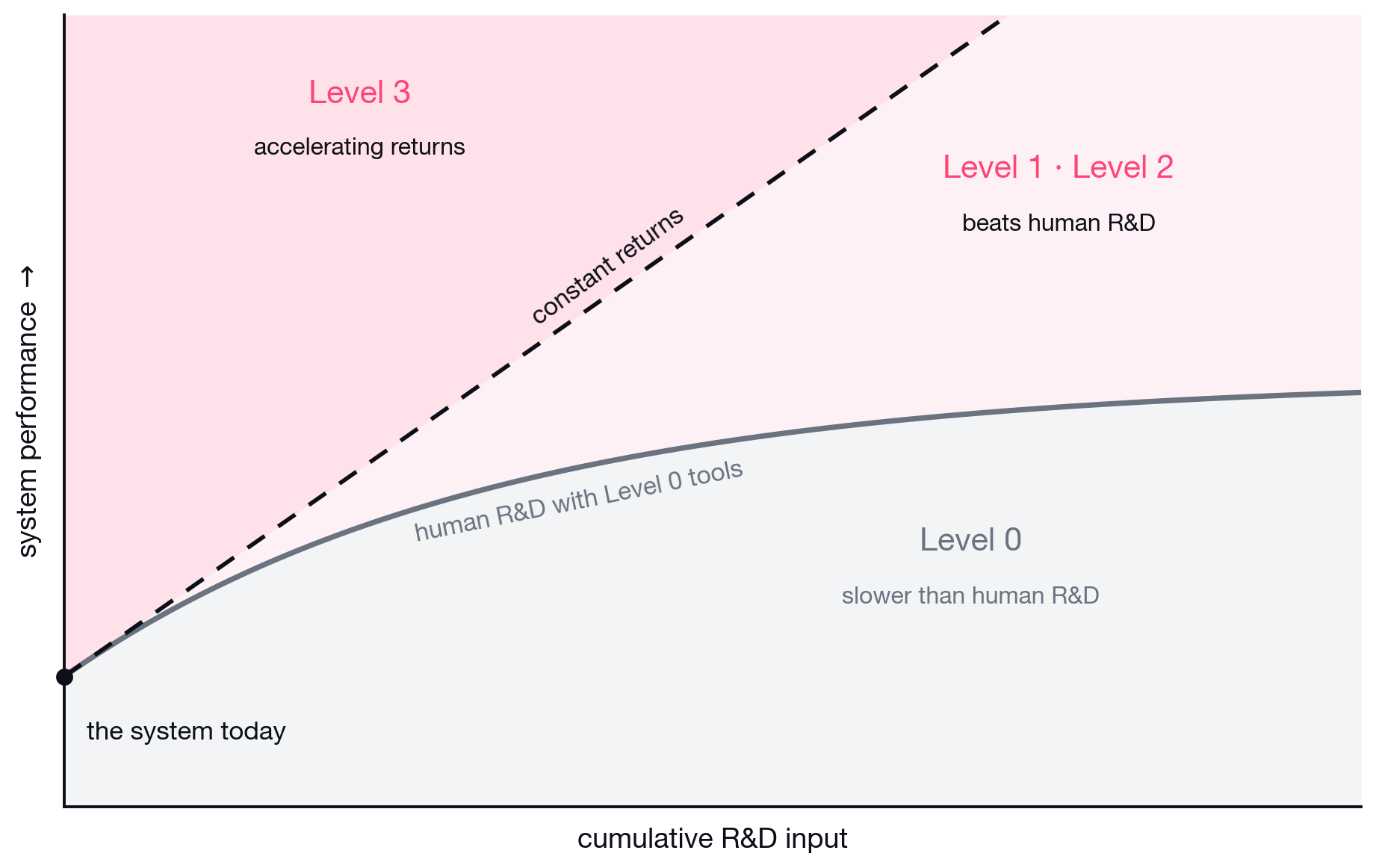
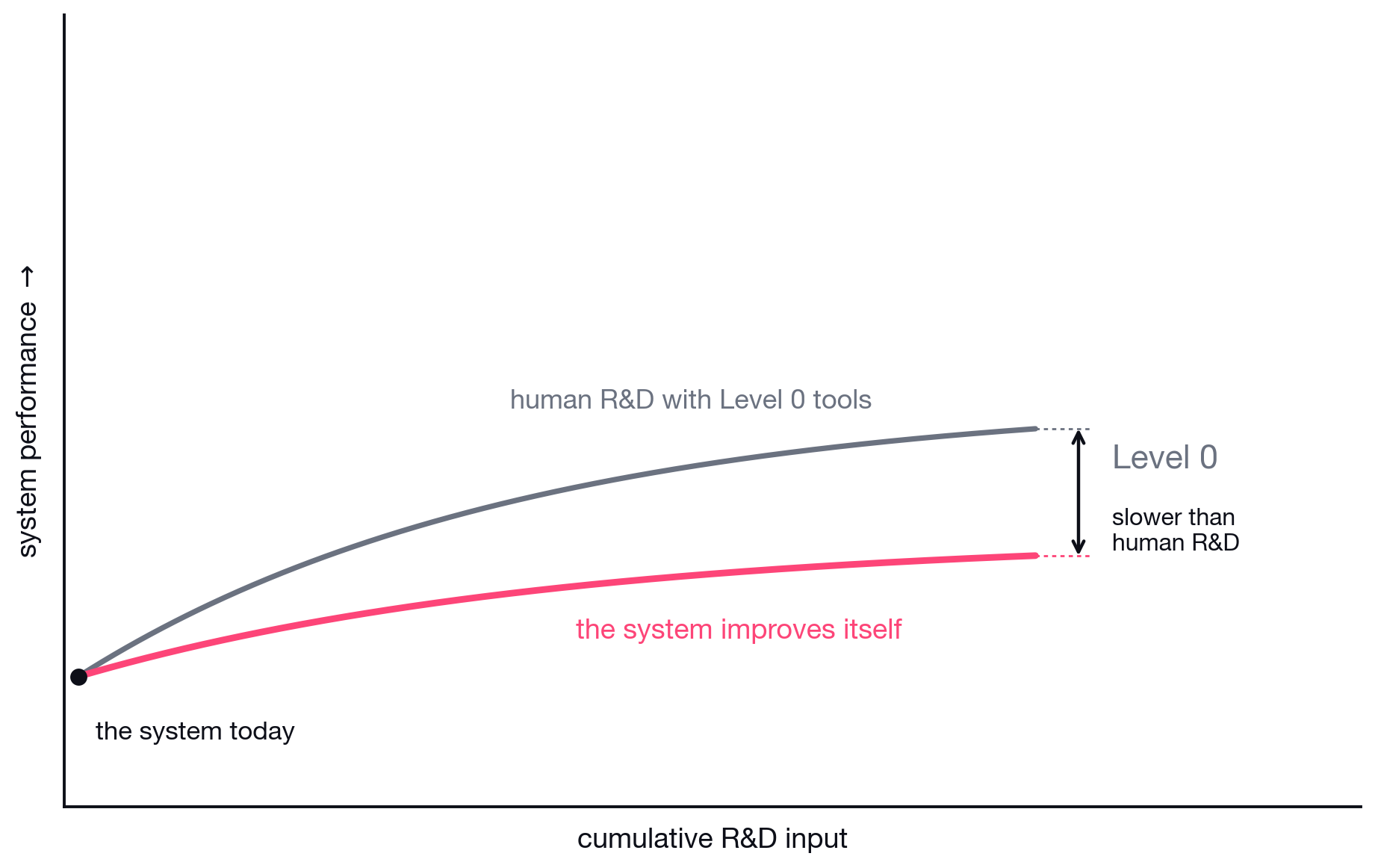
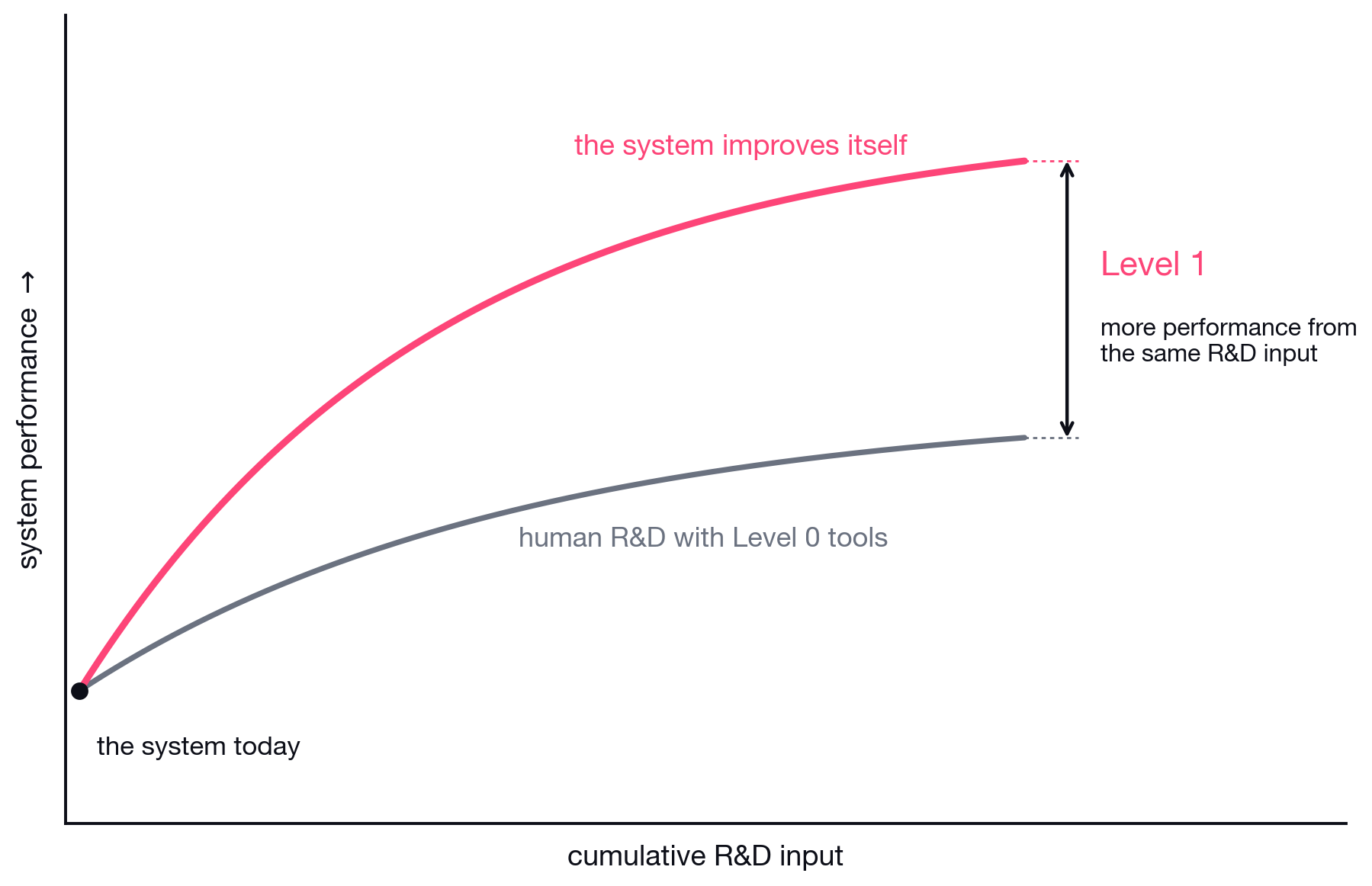
RSI is likely to lead to an intelligence explosion. Likely does not mean guaranteed. And RSI itself comes in strengths. So we divide it into levels, where a higher level means closer to an intelligence explosion, and each level is the necessary condition for the next. The count starts at zero, and Level 0 is the floor of the ladder. Every level is read off the same chart: the system improving itself, plotted against the baseline of humans improving the same system with AI tools at or below Level 0.
Level 0: delegation
Level 0 is delegation. You hand the research loop to an autonomous system end to end: it forms the hypotheses, runs the experiments and ships the improvements on its own. What keeps it at Level 0 is efficiency: the loop runs, but it improves the system more slowly than human R&D.
Level 1: net positive
Level 1 is net positive. An autonomous system improves itself, and does so more efficiently than humans improving the same system by hand with Level 0 tools.
To measure Level 1, we would internally use the following protocol:
- A fair human baseline. The humans may use any reasonable tool or resource except the system improving itself: any accessible literature, any code, general AI assistance. What marks the baseline is that a human closes each improvement loop.
- Sustained. The self-improvement is a consistent, multi-step trend, not a one-time jump.
- General. The system improves itself against some measurement X. The gains must transfer to real world utility, or a family of benchmarks Y, showing it discovered generally useful self-improvements rather than artifacts of X.
- Fixed budget. Performance on X is measured under a fixed physical budget. The gains must come from genuinely better algorithms, not from spending more.
Level 2: ignition
Level 2 is ignition. On top of Level 1, the system does not just improve itself; it improves its own ability to improve itself. The distinction is easy to miss. A Level 1 system optimizes itself against X, and its gains transfer to Y. But better on Y does not guarantee the loop compounds: for that, the gains on X must generalize to the system's own self-improvement ability.
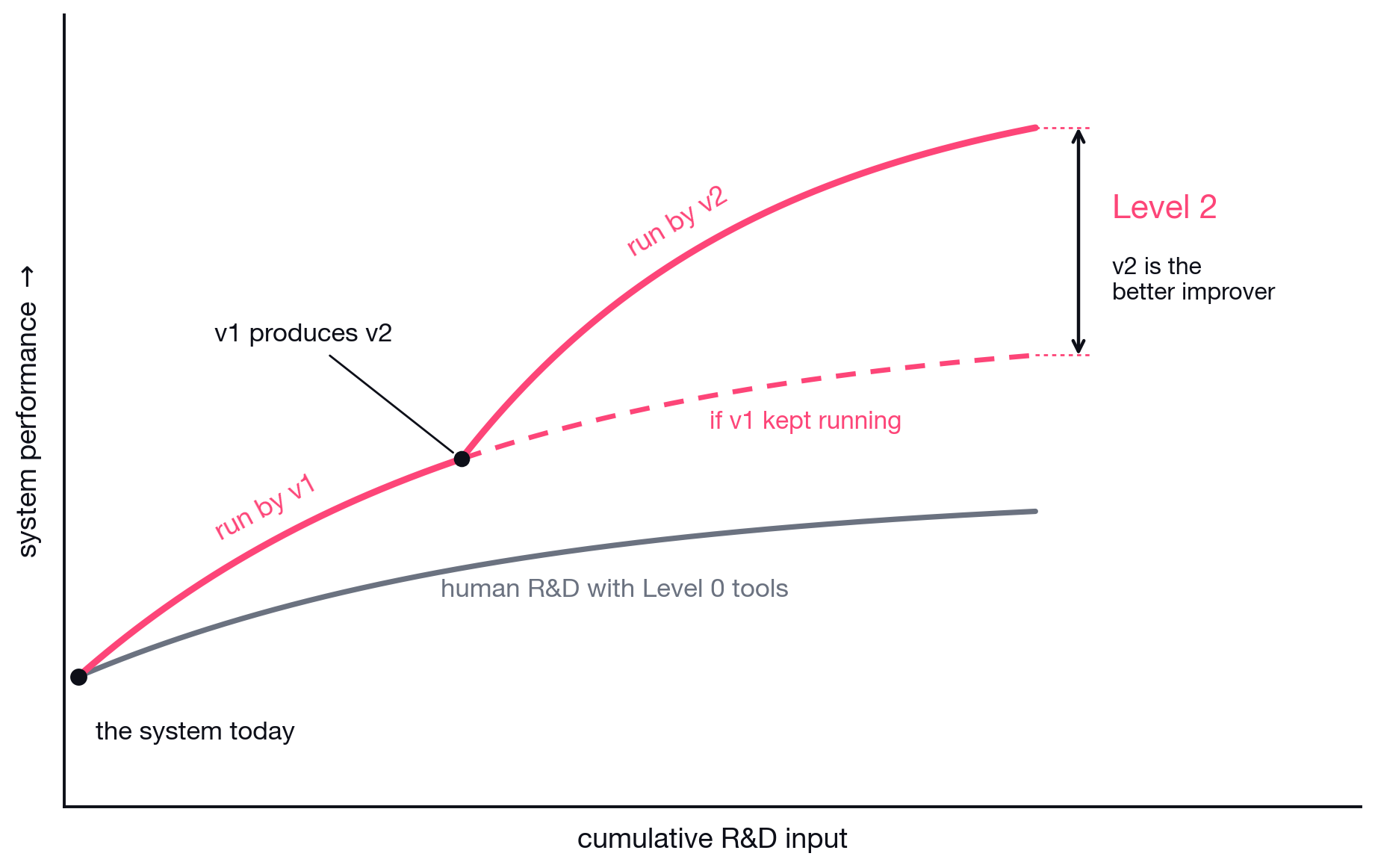
Concretely: v1 improves itself into v2. Now let v2 take over the campaign. Ignition means v2 is a better improver than v1 was: the v3 it produces beats, at the same budget, what v1 could have produced.
Level 3: inflection
Level 3 is inflection. The positive feedback loop overcomes diminishing returns. Progress accelerates even with a fixed amount of effort, for example as measured by R&D investment. Ignition says the loop can compound. Inflection says the compounding outruns the rising difficulty. The practical test: the gain each generation buys, at a fixed budget, grows instead of shrinking.
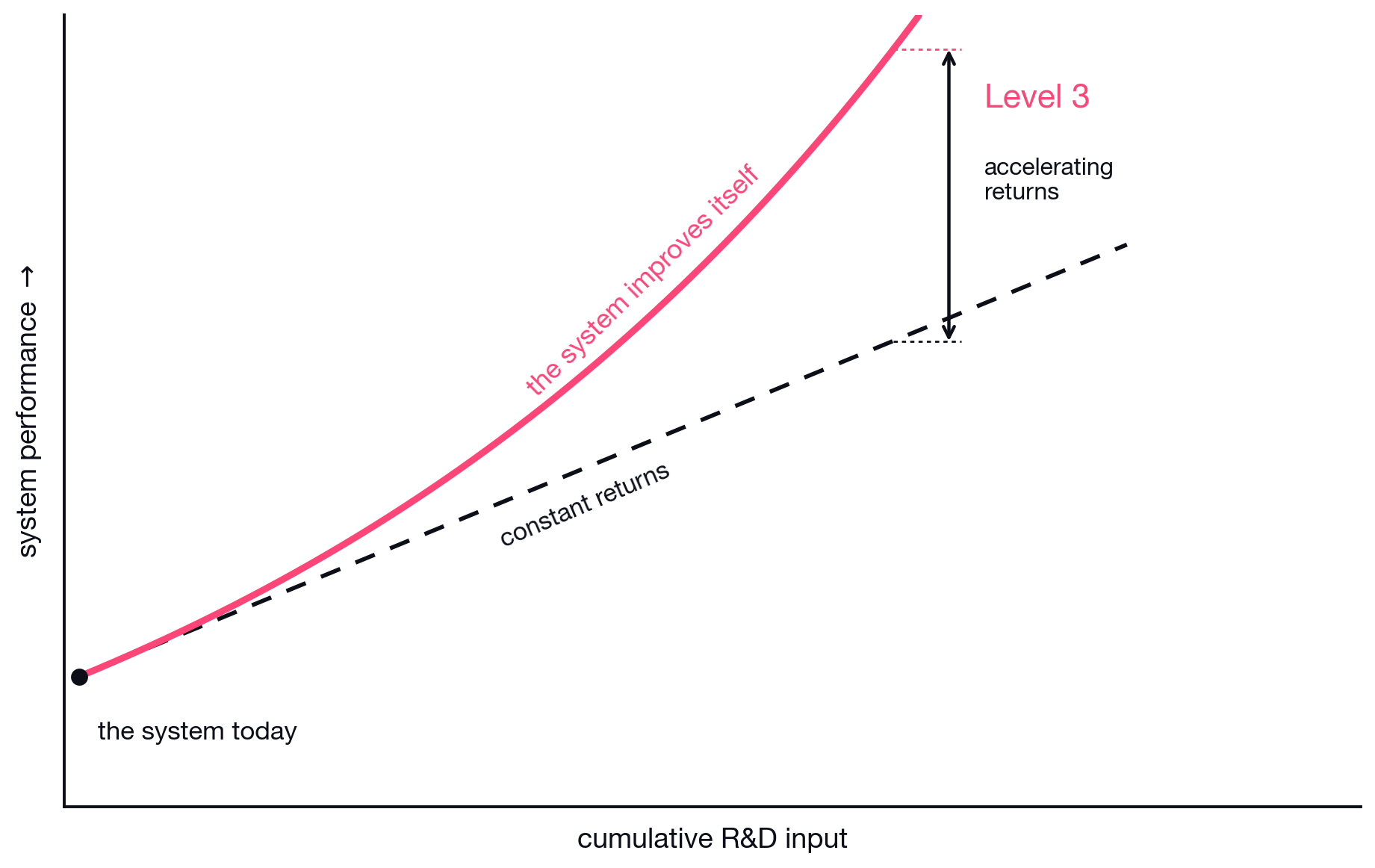
Net positive improves the returns on R&D once: a better research process buys more per unit of effort. But the curve keeps its shape, and if the improved system cannot become a better improver, the same diminishing returns eventually catch up. Ignition is when the returns improve at every promotion, each time a newly discovered system takes the improver’s seat. That is when the “recursive” part starts compounding. Ignition still guarantees nothing: designing better autoresearch systems itself gets harder, and the compounding has to outrun that. Ignition only means the mechanism can work. Inflection is the hypothetical scenario where the recursion, together with the other learning mechanisms, finally outweighs the rising difficulty.
A mining metaphor. The deeper you dig, the harder the ore is to reach: diminishing returns. Net positive is building a mining machine out of the metal you dug up; it mines fully automatically, much faster than human mining. Ignition is when digging deeper yields better metal, and the better metal builds an even better miner. Inflection is when that loop grows so strong that for the same effort in, time and money, the mining speed no longer slows down as you go deeper.
Where existing systems sit
Most current claims live at Level 0. Prior self-improving systems, the Darwin Godel Machine11Darwin Gödel Machine · arXiv:2505.22954, the Huxley-Godel Machine22Huxley-Gödel Machine · arXiv:2510.21614 and HyperAgents33HyperAgents · arXiv:2603.19461 among them, demonstrated the concept, and Lilian Weng’s overview of harness engineering44Lilian Weng · Harness engineering collects many more. A loop can rewrite its own code and climb a benchmark, and can even rewrite its own self-improvement machinery. Demonstrating the concept and accelerating actual research are different claims, and the ladder grades the second. We would assume those systems, when they were built, were at Level 0, but we also cannot rule out that some of these algorithms could reach Level 1, or even Level 2, with proper implementations and with frontier models.
Some evolutionary search and autoresearch systems deployed in production might already reach Level 1. For example, AlphaEvolve55Google DeepMind · AlphaEvolve sped up kernels in the training stack of the very models that power it, beating what human engineers had shipped. But those systems usually point at a specific sub-problem, optimizing a module like a matrix multiplication kernel, and with that alone it is difficult to reach the higher levels of the ladder: the theoretical ceiling of the improvement is limited. The higher levels need an optimization space with a much larger scope, and therefore a much larger ceiling.
We have been running this measurement ourselves: a recursive self-improvement system, evaluated against exactly the conditions above. The concrete results are now out: AIDE²: The First Evidence of Recursive Self-Improvement.
Citation#
Please cite this work as:
Weco Team, "4 Levels of Recursive Self-Improvement",
Weco AI: Blog, July 2026.
Or use the BibTeX citation:
@article{weco2026rsilevels,
  author = {{Weco Team}},
  title = {4 Levels of Recursive Self-Improvement},
  journal = {Weco AI: Blog},
  year = {2026},
  note = {https://www.weco.ai/blog/4-levels-of-recursive-self-improvement}
}